Southern Maine, Season by Season

Tuesday, March 14, 2017

Memory and Montecatini


Memory and Time Travel

I've just finished a book by science writer James Gleick called Time Travel: A History. Here is the cover: 



This is a provocative, if not entirely satisfying, look at the idea of time travel, from the original publication of H.G. Wells's The Time Machine (which, Gleick claims, is the first fully realized description of the exploration of time as if it were equivalent to space) to modern approaches to quantum theory that not only allow for time travel but may actually require it (the idea behind the recent film Interstellar represents a stab at imagining this).

While the possibilities and paradoxes of time travel are fascinating, to say the least, I'm not really concerned with the idea of either returning to an earlier epoch (a la Mr. Peabody and Sherman) or sampling the future (a Wellsian notion, to be sure, but one that's had a terrific recent reworking in Iain Pears's Arcadia).

I'm more interested in memory. In the final chapters of his book, Gleick ponders the idea that memory is a kind of time machine, although it's so necessary and familiar a function that we do not think of it in that way. Memory is certainly not an exact and unchanging look at the past - it is altered and colored by time, point of view, and subsequent information (but "true" time travel may also alter the past, as events are always changed by the presence of an observer. Mr. Peabody knew this!).

Down Memory Lane with Gourmet


Readers of this blog will remember my devotion to the late Gourmet magazine as a trusted source for all things epicurean. I have retained a goodly number of issues of the magazine from my 25+ years of subscription, and I have stored and sorted them by month. So the beginning of every new month is also, for me, a a period of re-acquaintance with the seasonal delights that were offered to readers 10, 15, even 20 years ago. These back issues comprise a fair cross-section of changing American attitudes towards cooking, eating, travel, sustainability, animal rights, the rights of migrant farm workers, and the changing idea of the family farm. The ads are fascinating (and sometimes cringe-worthy) time capsules of their own. Did women really wear big hair like that? Cigarette ads in food magazines?

And sometimes the ads carry a bit of personal nostalgia. There's one from the March 1994 issue featuring the superb Irish fiddler Kevin Burke, which implied that world-class talent like his could be found in any roadside pub in Ireland. I am devoted to Kevin Burke's music, and I'm consistently delighted to see his sly grin pictured along with a discussion of Rhone wines and one of my favorite Spring menus (lamb chops, risotto, asparagus, with a lemon-strawberry tart. Heaven on a platter!).

Naturally, even my fairly extensive collection could be expanded. I recently found that one could purchase single copies of Gourmet issues on eBay, and I succumbed to a couple of offers. I remembered all of the covers of the four issues I received, and all of them had some meaning for me : November 1983 (for the birth of my son), December 1983 (for his first Christmas, and our first in our house), April 1996 (because Easter is coming) ... and then there was this spectacular cover, from June 1984:


I remembered the brilliant photo well. But I did not recall the contents, until I sat down the other morning to a leisurely perusal of my new (old) issues. And there it was - a story for the series "Gourmet Holidays" by the venerable editor and travel writer Lillian Langseth-Christensen. It was all about a holiday in a northern Tuscan spa town, called Montecatini Terme. And suddenly, Marcel Proust and his "Temps Perdu" had nothing on me. I needed no shell-shaped cookie to return to the slanting golden light of that mountain town in October. I was back there, once again.

Montecatini

In October 2004, I had the opportunity to visit Italy - mostly Tuscany and Umbria, with a final foray to Rome - with a group from eastern Massachusetts. One of my friends, Barbara, had initiated the trip and recruited me, and I in turn recruited my good friend Mary. Our travel group was comprised mostly of women, and most of us were experiencing Italy for the first time. Our base of operations for the first part of the journey was - you guessed it - Montecatini Terme. I'd never heard of the place, but quickly became enthralled by its gracious hospitality and lovely surroundings. It is an old spa town ("terme" refers to the curative waters of the place), but it dates back only to about the 18th century, and not to classical Roman times. 

(Full disclosure:  the following photos are scans of actual film shots I took whilst in Italy. Some haven't the crispest focus; for this I apologize. My current digital does a FAR better job!)

Facade of the Montecatini Spa building
 
 The architecture of the spa's public buildings is florid (as shown above), but residences and hotels are more restrained and practical in their designs:
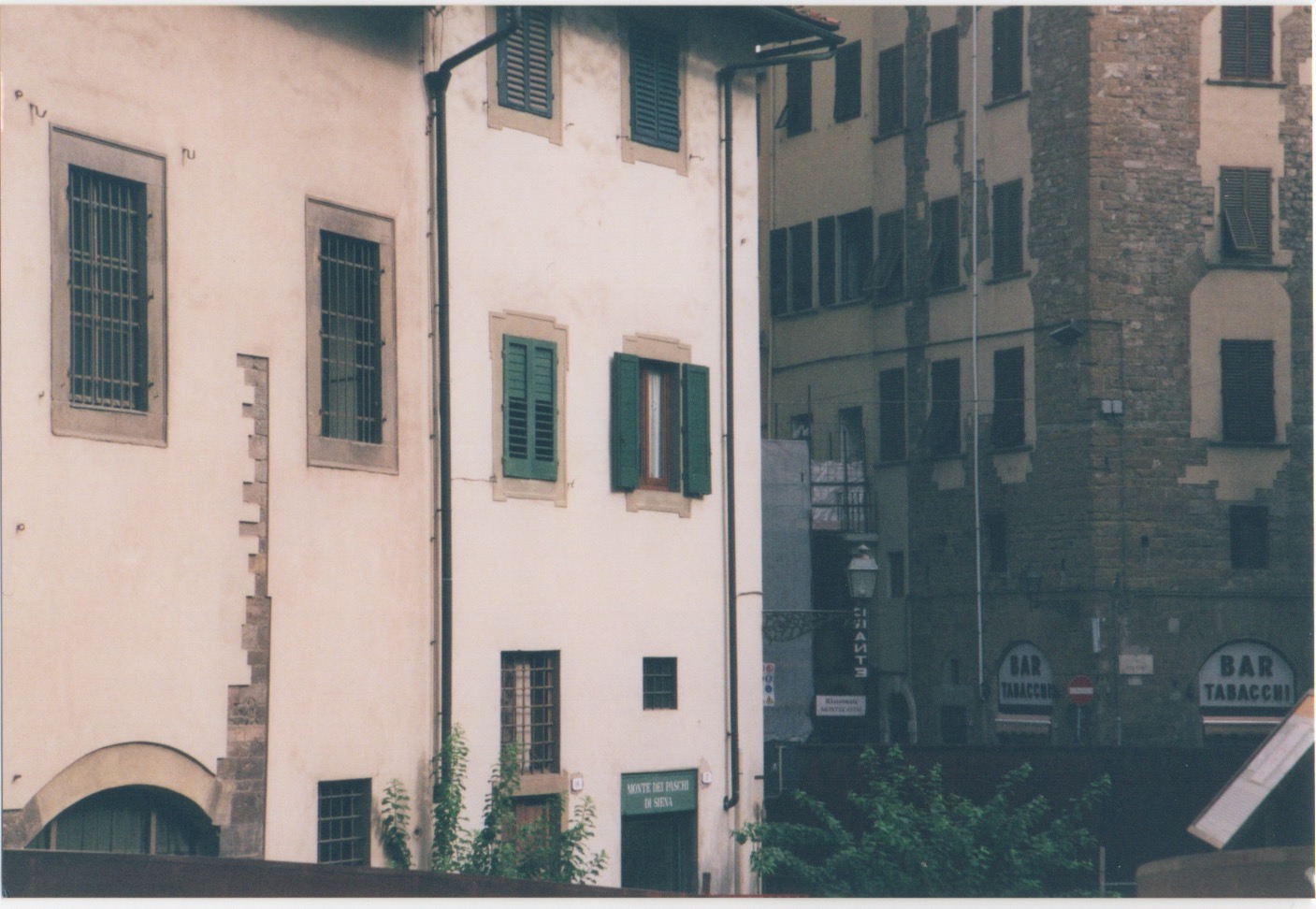
Montecatini Terme street scene

The Grand Hotel e La Place (NOT my hotel ...)


Bougainvillea in front of a modern bank building in Montecatini

Some of the most memorable moments of the trip were spent in this small spa town. In the evening, everyone ventures out into the streets for shopping, socializing, and coffee. I skipped the shopping, but was charmed by the coffee shops, which often feature delectable goodies to nibble along with the strong Italian coffees. I discovered that nougat candy could be fresh and melting and redolent of almond, unlike the dusty dry tablets I'd tasted Stateside.  Walking the streets until early morning was a pleasure to be savored. A small group of friends decided we needed to return, and open an American-style breakfast establishment in Montecatini (the typical Italian breakfast of an espresso and a hard roll with a bit of cheese or salami was not to everyone's taste. I, on the other hand, loved it).  Sadly, I don't think any one of us has yet returned. That may change ...

Montecatini sits in the foothills of some lovely mountains, and it is linked to an older town higher in the hills called Montecatini Alto. Alto can be reached by funicular from the spa town, and I was fortunate enough to take the trip. I was immediately charmed by Alto - its colorful homes, medieval churches, slanting streets and friendly residents:

We were told that this is the house of a renowned cook.

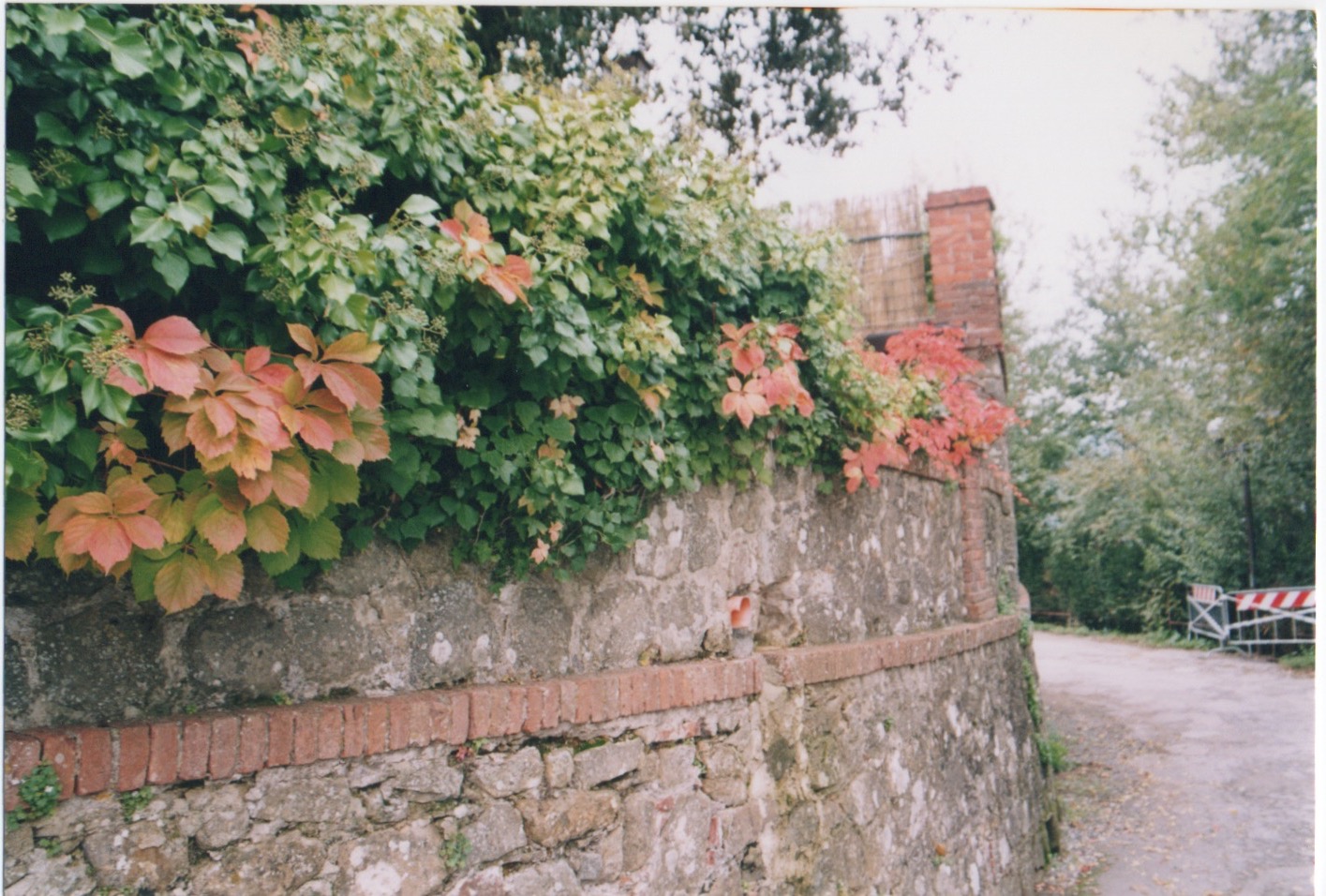
Turning leaves on an old stone wall


The streets of Montecatini Alto can get pretty steep
A beautiful terra-cotta horse head near the door
_________________________________________________________________________________

Memories of Italy - another food column

Last month, I re-published a column I'd written for my home town paper. Here's another from that series, and it's about my Italian journey. Although photos and stories in old magazines may be excellent spurs to the memory - and even a means of returning to a time and place - there is nothing like a good meal to REALLY accomplish time travel. I offer the following - for those who have experienced Italy, those who have gone, and especially for those who (like me) can't wait to return: 
 
Whether in Rome or Not… Eat Like the Romans Do!

”Forget the churches. Go for the food,” a knowledgeable mentor advised my friends Barbara, Mary and me as we set out recently on a whirlwind tour of Tuscany, Umbria, and Rome.  Well, our friend was half right!  Whether it was the unbelievable frescoes by Giotto and Cimabue that grace the Basilica of St. Francis in Assisi or Michelangelo’s breathtaking marble dome over St. Peter’s, we were dumbstruck by the magnificence to be found in the churches of Italy.  But we were equally impressed by the gustatory treasures we discovered.  And upon returning home, we were fortified by three simple goals: to rest our feet (beleaguered after tramping through half of the peninsula), to reconcile our sensibilities to the fact that our beloved Sox had FINALLY become the champions we always knew them to be, and to find the ways and means of recreating those exquisite Italian specialties we’d tasted and swooned over.

Well, my feet are once again functional, I don’t have to pinch myself every time I see a World Series Championship T-shirt, and I’ve been able to put together a half-decent Tuscan meal from the surprisingly lush offerings of nearby shops.  I still need to do a lot of experimenting and tasting before I’m satisfied, but here are a few suggestions for putting together a lovely meal with distinct overtones of Bella Italia.

We must start, of course, with an antipasto, and the best example of this course I tasted was in a rollicking trattoria in Rome.  At the beginning of an astonishing six-course meal, I was served a layered appetizer consisting of thin slices of delicious cured beef, topped with baby arugula and shavings of sharp Parmigiano-Reggiano.  The plate was dressed simply with a squeeze of fresh lemon juice.  Something so simple and so luscious should be easy to recreate, right? Well, yes, if you can find the requisite ingredients.  And residents of Burlington can do just that, ever since Lorella & Famiglia opened on Cambridge Street.  They sell bresaola, you see, which is the cured beef I loved in that Roman antipasto.  It’s expensive, but you will need just a quarter-pound (sliced thinly) to serve six lavishly.  Fan four or five slices out on a salad plate, top with a handful of baby arugula (which is easily found at Market Basket or Roche Bros.), and shave some very good Parmesan cheese over the top.  I brought back a kilo of the real stuff from Italy, but Lorella & Famiglia carry what looks and tastes just like the hunk I am using.  For your lemon juice dressing, try and find a Meyer lemon (at Whole Foods, perhaps), for these are slightly sweeter than regular lemons and match beautifully with the meat, greens and cheese. With this course, serve a bubbly Prosecco (Italy’s wonderful answer to vintage Champagne, and at a fraction of the cost).  This is a delicious appetizer for almost any meal, but if you want to vary it just a bit, the dry-cured capicola that can be found at La Cascia on Cambridge Street works just as well as the bresaola.

Now, a proper Italian meal would continue on to one of several primi piatti.  I suggest a sumptuous risotto made with dried porcini mushrooms for this course.  Again, you can obtain dried porcinis at Lorella & Famiglia, but they are widely available in other locations as well.  For the risotto, soak between 1 / 2 and one ounce of dried porcini mushrooms in one cup of warm water for about 30 minutes.  In the meantime, finely chop one small onion, and sauté slowly in one tablespoon olive oil in a heavy saucepan until it is tender and translucent.  Do not allow the onion to brown.  Add 1 / 3 cup Arborio rice to the onions, and sauté the grain lightly.  Squeeze the mushrooms until they are almost dry, and reserve the soaking liquid. Chop the mushrooms coarsely and add to the onions and rice.  Turn the heat to medium-low, and begin to strain the soaking liquid into the pot, about a quarter-cup at a time.  Stir vigorously with a wooden spoon until the liquid has become thoroughly absorbed by the rice.  Add another quarter-cup of liquid and continue the process until the liquid has been used.  Add 1 / 4 cup dry red wine to the risotto, and stir until the rice has absorbed the liquid.  Add 1 / 2 to 3 / 4 cup low-sodium fat-free beef broth to the risotto in small amounts, stirring each time until the rice has absorbed the liquid.  The whole process may take 45 minutes to an hour, but it is worth the effort and care involved.  Check the risotto to make sure the rice is thoroughly cooked, and to adjust seasoning. Add salt and freshly-ground pepper to taste.  It may require up to 1 / 2 teaspoon salt or more. The result of all this stirring should be a creamy porridge-like dish with the deep aroma and flavor of mushrooms.  If you want to make it even more luxurious, drizzle a little black truffle oil over the top of each serving. 

Serve the risotto with a green salad and a slice of Tuscan bread (made without salt), and pour a Chianti Classico to complement the wonderful flavors.

Now, I would stop right here, and have some fresh fruit and a café for dessert.  But those who are truly eating in the Italian manner may wish to proceed to the main course!  Here I might suggest a grilled meat dish, perhaps chicken or veal.  Roche Bros. has offered some excellent small veal chops in recent days, and Lorella boasts some wonderful-looking well-trimmed chops.  Add some roast potatoes, and your Tuscan meal will be complete.

And if all this sounds like too much time given to both preparation and to eating a meal, recall that in Italy dinner is an event in itself, rather than a prelude to some other activity.  Dinner should be planned and cooked with care, and consumed slowly, spiced with plenty of conversation, laughter, and good feeling.  So, invite family and friends to enjoy an Italian supper. Get out the linen napkins, light the candles, spin some Renaissance dances or Puccini on the stereo, and enjoy good food and togetherness. Buon appetito!


Tuesday, February 28, 2017

Shrove Tuesday

The End of Winter


Snowdrops bravely begin to poke through the mulch of dead leaves and pine needles


Shrove Tuesday, also known as Mardi Gras, is the last hurrah of the winter holidays that begin (in the US) with Thanksgiving and end with the Carnival season. It's a time to enjoy one last blast - a waltz with a jelly doughnut and some Champagne if you're in a Viennese mood; or jambalaya, a Sazerac and some two-stepping if your preference is NOLA Style.

In any case, it's the end of winter and time to herald the first stirrings of Spring. For many of us still bound by snow and cold, that last claim seems a little preposterous. But - look around you. Days are lengthening. The sun is stronger. Gardening catalogs, which began to arrive around Christmas, now stuff everyone's mailbox - and produce vivid daydreams of green grass, bright flowers, and the first taste of garden lettuce and peas. Oh, yes - it's coming!

Lent, the Christian penitential season that begins tomorrow, is derived from an ancient word meaning SPRING. It's also a lean season; a welcome change following the weeks of hearty holiday and winter fare. We are encouraged - whether for the good of our souls or the health of our bodies, or (better yet) both - to plan smaller meals around fish rather than red meat, or to eschew animal products completely.  One of the old traditions for Shrove Tuesday was cleaning the house and discarding the preserved meats and winter vegetables left over from the harvest and butchering times of the autumn. A sound practice! Dairy products are usually also in short supply on traditional Lenten menus. Milk and eggs, along with sugar and butter, were often used up creatively before Ash Wednesday. One of the alternative names for Shrove Tuesday in Great Britain is Pancake Day - pancakes are made by the dozen and topped with rich and creative (and sometime boozy!) additions. Some towns (such as Olney in Buckinghamshire) hold Pancake Races, which involve women running a course from the town center to the church, flipping pancakes in pans as they go.

Lent, though it heralds spring, is certainly still prone to winter weather and its attendant gloom. It's hard to wait, sometimes, for the coming season! I recall, as a young girl in Minneapolis, trying to wear my green spring coat to Mass on St. Patrick's Day, just because it was green and therefore seasonal. I about froze my butt off. And I did that TWICE. Hope does spring eternal, at this time of year!

  ________________________________________________________________________________

Speaking of freezing, we had a major snow storm or two a couple of weeks ago - lots of shoveling and worries about the weight of snow on the roof and suchlike. I ventured out, at the end of the week, determined to see some sun and blue sky. I went to Portland to walk around the Back Cove, a pleasant 3.5 mile walk around an arm of Casco Bay. Well, a usually-pleasant walk. This day was sunny but very blustery, and the path ranged from merely snow-covered to ice to slush to deep puddles. It took me a good hour and more to do the walk, but it WAS lovely. Here are a couple of photos:

Back Cove, east side

Thawing beach, west side of Back Cove


____________________________________________________________________________________

Lemons, recipes, and a look back at a food column

One of the most welcome Christmas gifts I received was a box stuffed with fresh Meyer lemons, from my stepson and his wife, who live in California. Meyer lemons have a peculiar (to me) scent, but a wonderfully fruity and even mildly sweet lemon flavor. But the scent of their rind smells to me like pine sap; very resin-y. Perhaps it's just me! But the freshness of the fruit, and the wonderful taste of the juice is too much to resist. I began making lemon-based desserts and salad dressings immediately. I thought of chess pie, which often is flavored with lemon juice. And then I thought - well, I've written about this before! 

You see, I used to write a regular column for the local newspaper when I lived in Burlington, Massachusetts. It was a while ago, but I sometimes like to look back on some of those columns. Okay, I'll reproduce one right here. It has some local references (I was trying to support a wonderful Italian provisions shop in town, but - sadly- it didn't last for long ...) but the recipes are still good. And it does suggest a good version of chess pie, with lemons. So, here goes: 

 
Meyer lemons!


Stand in the Place Where You Live … Now Face South (original title)


            Okay, I couldn’t take another minute of the cold and the snow. I had a strained shoulder from shoveling, and so help me, my beloved Packers were gonna lose big.  It was Florida time, and no mistake.

            Ah, Florida. A pilgrimage to Bahia Mar (required of all Travis McGee devotees), mind-numbing trips to erstwhile art galleries (that’s art? Are they kidding?) and lots of horizontal time by the pool with a good book and a tropical drink at the elbow.  It might be the end of the world as we know it, but I did feel fine.

            Part of that good feeling had to be from the fare provided us at the local restaurants.  From traditional Cuban specialties to stone crab to incredibly fresh tuna and a superlative vanilla bean ice cream – I found a lot of reasons to visit the gym.  But the good news is that many of the best dishes were low in fat but big on flavor and satisfaction.   Since I’ve been back in the chill of New England (and yes, just in time to cheer on the Pats at the Razor) I’ve been experimenting with some Southern flavors to try and recreate the feel of Florida in January.  I’ve hit upon a fair recreation of a signature appetizer offered by the outstanding Fort Lauderdale oceanside restaurant 3030: seared scallops with garlic-flavored sautéed spinach, wine-braised mushrooms and a balsamic vinegar glaze.   Since this dinner is delicious, but low in fat and calories, why not splurge just a bit for dessert with a classic (but slimmed-down) version of a Southern specialty: chess pie?

            For this menu, the quality of the main ingredients will really decide whether you have a merely good meal or a really amazing one. If you can find fresh sea scallops, (try Roche Bros. or a large seafood market) by all means buy them – and use them immediately.  If really fresh scallops are scarce, try the large frozen ones offered by Trader Joe’s – but thaw them quickly before use, in ice water.  A pound of scallops will feed four diners.

            But begin with the mushrooms.  Purchase about one pound of large white mushrooms, clean them, and cut them into quarters. Melt about one tablespoon of butter in a sauté pan, and add the mushrooms.  Sauté over low heat until the mushrooms begin to give up their liquid.  To the liquid add about 1 / 4 cup dry red wine, and cook slowly, stirring, until the liquid has been absorbed and the mushrooms are glazed a deep brown-red. Sprinkle with a bit of salt and pepper and keep the mushrooms warm over very low heat. 

            Next, turn to the balsamic glaze.  This, very simply, is good balsamic vinegar that has been reduced to a light syrup.  Pour about 1 / 3 cup balsamic vinegar (Lorella & Famiglia can provide outstanding balsamic, but the 10-year old Modena at Trader Joe’s will do just fine as well) into a very heavy small saucepan, and begin to reduce the vinegar over low heat. Watch this well; it can caramelize in a flash.  When the liquid coats the sides of the pan when you swirl it, the glaze is ready. Keep it warm at the back of the stove.

            Now, prepare the scallops.  Heat a heavy skillet or griddle, and melt about a tablespoon of butter on it.  Blot the scallops well with paper towels before placing them onto the hot skillet.  Sear the scallops until they are a deep brown on both sides, and then lower the heat to cook the seafood thoroughly.  Do not overcook! Check the middle of the scallops to ensure they are just opaque all the way through.

            While the scallops finish cooking, quickly toss two peeled and minced garlic cloves in one tablespoon olive oil that has been heated in a sauté pan or a wok.   When the garlic is sizzling, add one large package cleaned baby spinach leaves, and sauté until the spinach has just wilted and heated through.

            Serve the scallops on a bed of the hot spinach.  Scatter the braised mushrooms around the scallops, and make a puddle of the balsamic glaze in one corner for dipping the scallops.  Serve this elegant, quick dinner with chewy ciabatta bread from Lorella, and a sophisticated Fumé Blanc.
           
            For dessert, try a very simple, quite light version of Chess Pie.  Prepare your favorite pie crust in a 9-inch pie pan. Press foil and pie weights onto the crust, and bake it at 425 degrees, until light brown, about 12 minutes.  Let the blind-baked crust cool.  Mix two eggs, two egg whites, one cup sugar, two tablespoons flour, the grated rind of one lemon, two tablespoons fresh lemon juice, and one teaspoon vanilla.  Slowly add one cup lowfat buttermilk, whisking constantly.  Pour the mixture into the baked shell, and bake at 350 degrees for 35 minutes, or until the center is just set.  This pie is delicious on the day you make it, but it is even better a day later, if you can wait that long!

            Ah … the flavors of Florida. It should hold me ‘til next time

_________________________________________________________________________________


More food photos


Lemon meringue pie - without the crust. Try it! 


King Cake - for Mardi Gras!


 _________________________________________________________________________________


Some Seasonal Flowers


How can you go wrong with primroses? 


______________________________________________________

  A Preview

  Are you ready to plant a garden yet? Okay, it's a bit early. But here's something to get you thinking both of the garden AND the pollinating insects that make the wonderful fruits and vegetables and flowers possible, year after year. Bees, especially honeybees and native bumble bees, are having a hard time of it. It is to our advantage to plant and maintain gardens that will attract and support these critical pollinators. I will be making available, through my web site (OffMill.com) embossed paper disks impregnated with seeds for bee-friendly plants. Just plant the paper disk for a small meadow of mixed flowers. Here's a preview of what they look like: 

Bee paper
 Watch for the OffMill.com launch! 

Saturday, December 17, 2016

December

The Black Month

Do you associate months, or days of the week, with colors? It's a form of synesthesia, and it's probably quite a common thing. One neurologist, the late Dr. Oliver Sacks, speculated that synesthesia may be developmental; that is, perhaps sensory pathways may be connected in a young child until time and learning separates them into different categories of memory and experience. Perhaps those pathways remain tangled in some ways, in some people, into adulthood. You'll probably gather from this introduction that I do experience a type of synesthesia, and it does involve color. Among other things, I do associate months closely with various colors. And December is definitely black.

That's not to say that I think of the color black when I think of December. It's that the month ... IS black. It feels black; it is opaque, and has a fragile, almost powdery texture. The feeling is a little like melting into a chalkboard. It means that on a snowy December day, like today, I feel the black bark of the trees, instead of the white flakes that cover them. Too weird? New Year's Eve is always a sensuous experience for me, as black December gives way - quite suddenly - to the dazzling white, ethereal, and icy texture of January. And only then can I feel the snow.

But enough about my weird sensations of the month. Because it is black, December is the perfect background for the night constellations and the changing moon. It means also that I have real preferences for the colors and textures of Christmas decorations. Bright red and green don't do it for me. But small, icy lights echo the stars' presence in the velvet black sky. And muted colors - blues, silvers, pinks, natural greens - contribute a sophisticated and satisfying palette. Like this:

Our magnolia, adorned with "white" incandescent and LED lights. Really gold and blue, respectively. Maybe a few more lights, next year?

An illuminated snowflake on the front of the house. And yes, I really love the fact that the arms surround a Star of David.

Greens, birch poles, and incandescent white lights fill a snowy urn by the front door. You can glimpse a small tree on our back porch through the side light windows.

Mantel arrangement. Natural greens from the yard: boxwood, fir, and winterberries arranged in recycled glass jars covered with salvaged birch bark. The sleigh is a cardboard construction, and the banded rocks come from the nearby beach. The small hemlock cones that are tied to packing twine in the garland were windfalls on the deck of the house at which we spent a memorable week in Cape Breton this past October.
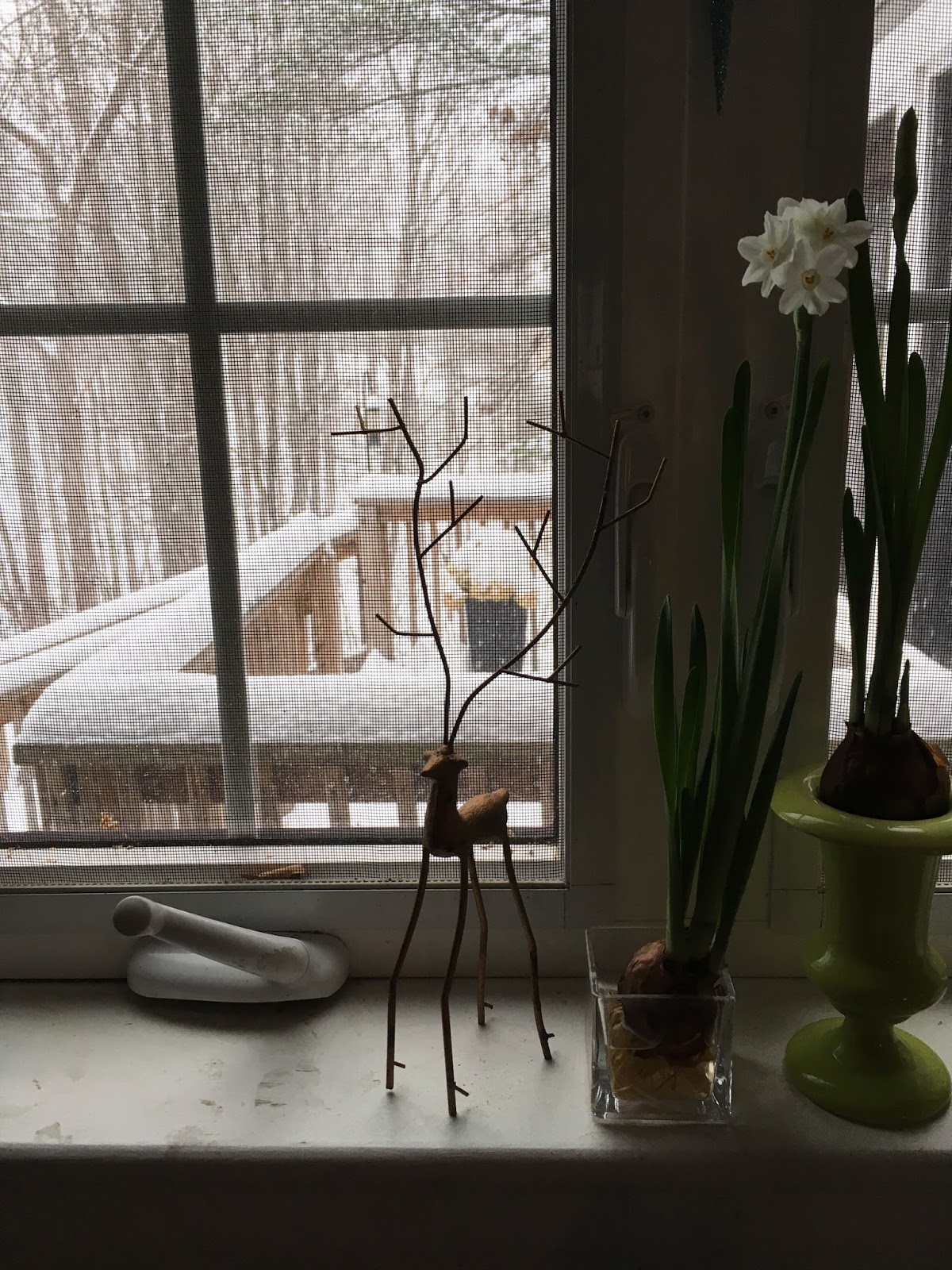
A small wire reindeer figure alongside individual bulbs of paperwhites.


Small Swedish dolls and a little tree with Swedish horses flank an old-fashioned clock on a vintage doily. 


A dark photo of the tree, flanked by snowy windows. OF COURSE it's the Perfect Tree! It always is! 


Some favorite ornaments


 ___________________________________________________________________

A trip to Boston

One of the nice things about being semi-retired is taking a trip to Boston (aka The Big City) for pleasure, and not for work - not that the two could not be combined! They often were ... 

Paul and I have a tradition of walking around in the city sometime in early December, to see what we can find. Often, it's a visit to a museum, and almost always, it's a walk around the Boston Common and the Public Garden.  This year, instead of staying at a hotel for a day or two, we decided to make a day trip by train. We left Wells in the early morning, and arrived well before noon at North Station. We enjoyed a brisk walk to the nearby Museum of Science, and took in the current exhibit on Leonardo da Vinci (which was great) as well as a smaller permanent exhibit on local birdage. 

Then we strolled down the Esplanade and Charles Street to the Public Garden to visit the ducklings.  Mrs. Mallard was  - as usual - adorned with her Santa hat, but this year, the ducklings had their own cold-weather gear!  


Here's Jack, the first of the ducklings

And here's Quack, bringing up the rear (queep!!)


 After a traditional New England dinner at Durgin-Park, we made the trek back to North Station and a homebound train ride in the dark - the perfect way to view the outdoor Christmas light displays of many, many homeowners and municipalities in Massachusetts, New Hampshire, and southern Maine.

_______________________________________________________________________________

 A couple of arrangements for Christmastime


Here's a loose arrangement of amaryllis flowers and some eucalyptus leaves in a plain gray pottery vase. The soft colors and exuberant forms of the flowers make an exciting, if unconventional, holiday focal point.

A Christmas arrangement to complement my "good" china, which is white and light blue. White tea roses, blue sea holly, and seeded eucalyptus are nestled between blown glass ornaments. It's all placed in a footed silver bowl.

_________________________________________________________________________________

 A Holiday Appetizer

Christmas is a time for getting out favored recipes from years past and enjoying the results with family and friends. It's ridiculous that I haven't done a Christmastime blog post before, and so have not shared some of my favorites for this time of year - Cinnamon Crescent, Mint Meltaways, Baked Alaska, Oxtail Consomme, Country Pate, Cheese Gougeres, Miniature Tourtieres, and - of course! - the entire Menu for the Feast of Beast, including Strawberry Sorbet and (yes!) Fruitcake for dessert. 

It'll all get shared - eventually. But here's a terrific, easy appetizer that you can share with just one other person. It comes together pretty quickly ... IF you remember to take the pastry sheet out of the freezer. Do so! 

Caramelized Onion and Goat Cheese Tarts

Serves 2, but can be doubled. Or tripled. Or fourpled. 

 Unfold one sheet of thawed puff pastry. Use Pepperidge Farm, and save the all-butter Dufour puff pastry for another time! Use 1/3 of the sheet (it will probably break that way, anyway).  Cut the pastry sheet in half and prick both pieces all over with a fork. Place the pastry squares on a parchment paper-lined baking sheet (or substitute a Silpat sheet) and bake in a preheated 450 degree oven for about 12 minutes, or until golden and puffed. 

Meanwhile, thinly slice a sweet onion (Walla Walla, Vidalia, or Maui) and saute the slices in 1 tablespoon of butter until light brown. Add 1/4 cup water and 1/2 teaspoon dried thyme to the pan, and cook until onion is fully caramelized, stirring frequently. Don't let it burn! 

Place the hot pastry squares on plates and immediately crunch the centers. Spread each pastry square with about 1 ounce of goat cheese, and top with caramelized onion. 

With a salad, this would make a lovely light lunch.  And, yes - add a glass of wine! After all, it's Christmas! 

May it be a merry one! 


Tuesday, September 27, 2016

The Season of Quickening


Harvest celebrations

September - a month of in-betweens.  This month brings a number of changes to navigate - the languid ease of late summer gives way to the burst of activity, regularity, and purposefulness that attends the return to school, work ... reality. September really marks the beginning of the new year, which ancient agricultural societies knew well. Once harvests had begun, the dreaded Hungry Time came to an end with rejoicing. 

We in modern societies have lost that seasonal touchstone - which is great from the standpoint of being able to feed more people in reliable fashion. Food security for more and more people is a mark of enormous progress, and we still have a long way to go to fully achieve this worthy goal. But in making almost every food available almost all of the time, we've also lost the sense of assurance that the community would make it through another year because of the labor of the growing season and the bounty of the harvest. This loss is not merely circadian but - more importantly - historical and societal. That sense of assurance tended not only to bind communities to their agricultural pasts, but also fostered recognition of our dependence on others in the community, and upon the natural world that nurtures us all. 

That assurance is the foundation of the Thanksgiving celebration - something that's hard to remember in the US, because of the accident of its late-November placement. I think Canada gets it about right. The second Monday in October is a time in the year when it's possible to capture some of the flavor of the old harvest-festival celebration, and it also permits the holiday to stand alone, unmarked by the looming onset of The Holidays. 

We were able to experience Thanksgiving in Canada last year, because we were fortunate enough to attend the North Atlantic Fiddle Convention (NAFCo) conference and festival in Cape Breton, Nova Scotia. Paul and I presented a research paper at the conference, and enjoyed the music of the Celtic Colours Festival, which was linked with NAFCo. But one of our most fondly-remembered experiences from the trip happened on our first night in Sydney, Nova Scotia. On the evening of the second Monday in October, we finished a nine-hour drive and checked into our suite at a marvelous downtown hotel. We were tired and hungry. We came downstairs to find that Thanksgiving dinner was being served in the hotel dining room. Turkey, all the trimmings, wonderful apple crisp - it was more than mere hospitality. It was home. Harvest Home, actually. 

The good news is that we're going back to Celtic Colours this year! No conference this time, but lots of music - and the promise of yet another Thanksgiving feast celebrated while the October sun sets in the west. 

Thanksgiving, of course, is not the only celebration of the harvest in North America. The New England agricultural fairs that begin in August and run into October began as rural community celebrations of life on the farm: the finest animals, the best produce, and local triumphs from the oven, the sewing machine, and the sugarhouse are all on display. And yes! There are the rides, and the horse-draws and the oxen-pulls ... and the ice cream! 

As we often do in late August, Paul and I visited the Cummington Fair in western Massachusetts again this year. Cummington is Paul's home town, and the Fair was a highlight of his formative years, spent on a beautiful and prosperous farm just up the hill from the fairgrounds. He had no trouble imparting his love of the Fair to me, and now I look forward to it every year as well. Here are a couple of photos from one of my favorite places at the Fair, the Exhibit Hall, which houses displays of produce and craft from local communities:

A blue-ribbon collection of garden produce. It's gorgeous!

This basket won fourth place - but I think it deserved better! 


On the way back from Cummington, Paul surprised me by stopping in Shelburne Falls, at the Bridge of Flowers. Seeing the Bridge is always a major treat. Here are a few photos of that lovely day:

This dahlia is called Fireball. I'm growing one next year!

Phlox and hibiscus, and look across to the roadway bridge.

More hibiscus and lovely autumn sedum.


______________________________________________________________

 A few photos from the September garden


The roses are in their second bloom!

Zinnias are really coming into full bloom.

This is the first season for the bold red hibiscus at the corner of my garden. It is stunning, if a little late in its bloom, due to its getting established rather later than it should have. Next season it ought to be spectacular.


One of my favorite roses - the Floribunda "Hot Cocoa": the color lives up to the name!


The white hydrangeas are almost through with their bloom. The florets are turning pink - a glorious way to age!


More hydrangeas.


And some phlox is still hanging tough!!

_______________________________________________________


And of course ...

My dahlia, "Pooh"! And yes, Christopher Robin, that IS the right sort of bee. Although you can never tell.

_______________________________________________________

An arrangement of late roses and lime-green licorice plant

_______________________________________________________

A recipe from the box

Why is it that when you go looking for a recipe for an old-fashioned treat, it is often SO difficult to find? In this case I mean a straightforward recipe for blondies (called by some blonde brownies). Everyone knows what they are, and I'll bet everyone can taste them subliminally. But just TRY to find a recipe! Gourmet cookbook? Nope. Not the Times cookbook, not even the Settlement or Joy of Cooking. Better Homes and Gardens (even my Mom's edition!) never heard of them. Martha couldn't be bothered, but how about Marion Cunningham? Not a word. Epicurious? Good luck.

I needed a recipe for blondies to bring to the family cookout at the farm during the Cummington Fair. I promised baked beans and blondies ... and once you do that, you've got to deliver.

Then came Paul to the rescue! His Mom's recipe box is crammed full of hand-written cards for delicious and interesting things (switchel, anyone?). And - there it was. Well, not blondies exactly, but something just as wonderful: Butterscotch brownies.  What are they like? Well, imagine a blondie. Now, imagine it taken to the max, in every way. That's a butterscotch brownie. Okay, okay, here's the recipe. Make 'em and swoon ...

Helen Howes Wells' Butterscotch Brownies

Melt 2 cups butterscotch bits (that's just about exactly a 12-oz bag of bits) with 1 stick butter in the microwave. Careful when you do this! Cut up the butter, and add it with the bits to a microwave-safe bowl. Cover the butter and bits with a piece of wax paper (or better yet, the butter wrapper) and microwave in short (30-second) bursts, stirring between bursts. Stop heating the mix before it is totally liquid; the residual heat, plus some stirring, will finish the melting. It will be a gooey mess in any case, but try not to heat it to the point where the butterscotch begins to separate. Everything will still work if it does separate, but the texture will be better if it doesn't.

Whew! Now, you can proceed with the rest of the recipe. Generously butter a 13" x 9" pan (I use glass) and preheat the oven to 350 degrees.

Add to the melted butterscotch and butter 2 cups packed brown sugar, and let cool for a few minutes. Beat in 4 eggs and 1 tsp. vanilla extract. In another small bowl, whisk together 2 cups all-purpose flour, 1 tsp. salt, and 2 tsp. baking powder. Add these dry ingredients to the batter, along with 1 cup chopped walnuts. Pour into the pan, and smooth the top. You can add more walnuts to the top if you like.

Bake for about 35-45 minutes. The center of the brownies should just be firm (not jiggly), and the edges should have begun to pull away from the pan. Let cool completely, and cut into small squares. Makes about 40 butterscotch blondies.

_________________________________________________________________________________

Enjoy the harvest! Just don't buy me a pumpkin spice latte with caramel swirl. Bleah.