Southern Maine, Season by Season
Showing posts with label Arcadia. Show all posts

Saturday, February 24, 2018


"Between melting and freezing

The soul's sap quivers."

Valentine's Day/Ash Wednesday, and Little Gidding


This year, two holidays, Ash Wednesday and Valentine's Day, occur together. It can't be the only time this has happened, although the coincidence is certainly not frequent. But since it HAS now happened, one can consider whether the coincidence has meaning.

At first blush, the celebrations seem diametrically opposed: Valentine's Day, in modern observance, is a day of celebrating the gifts and joys of love - whether it's the fondness expressed in exchanges of small cards in classrooms or the more significant exchanges of flowers, chocolate, champagne, and kisses among the more mature; Ash Wednesday observance includes wearing dust, fasting, and contemplating one's own death.

On second, thought, however, Valentine's Day and Ash Wednesday do share an important component - one, it may be argued, that is central to the themes of both observances. And that's the element of hope. We can easily see that Valentine's Day is a celebration of hope: Will you be my Valentine? Will you be mine? Will you accept these flowers, these sweets, these good wishes? The hope of budding romance (or at least a more cordial relationship) is the aim in all of these common sentiments of the Day.

It's a bit harder to see the hope that underlies Ash Wednesday, for never was there a day so laden with gloominess. It's an Eeyore-sort-of-day: Woe is me, for I am a mere mortal! The ashes mark us for burial; the words with which they are administered chill one to the soul, "Remember, man; you are dust, and to dust you shall return." It's the curse of the expulsion from Eden, and I often imagined (in my youth) that I could see the Inferno Dante described open up at my feet as I walked back to my pew. One wrong step ... and down I'd go.

What actually saves us from that tumble? It's hope. Yup, that same hope that leaves would-be lovers trembling at their own daring is the hope that illuminates drear Ash Wednesday. Yes, in a theological sense, Lent points us on to Easter. But Easter seems a long way off in the middle of winter. The hope of Ash Wednesday, like the hope of Valentine's Day, is what makes each new day progressively more bearable as the world whirls towards the vernal equinox.

I am certainly not the only one to have noticed that these two observances share common underpinnings. Each year, for example, my Ash Wednesday observance includes a close reading of the magnificent T.S. Eliot poem Ash-Wednesday. It's a long and somewhat difficult read, encompassing as it does so much medieval and Marian imagery. But the poem perfectly expresses (at least to me) the arc of Lent - from a stony resistance at the beginning ("Because I do not hope to turn again ...") to the melting and growth of Spring in the heartbreaking final stanzas. Eliot completely understood that Lent's foundation is hope. All you have to do to see that he understood the quivering hope of Valentine's Day as well is to turn to Portrait of a Lady, and read,
              
                               But what have I, but what have I, my friend,
                               To give you, what can you receive from me?
                               Only the friendship and the sympathy
                               Of one about to reach her journey's end ...

(Yeah, go ahead and read the rest of the poem; it's an amazing miniature of suppressed longing. Isn't that Valentine's Day in a nutshell?)


This year, however, my reading at the beginning of Lent (and in the evening of Valentine's Day) was from another of Eliot's masterpieces, the Four Quartets. These have been my favorite Eliot works (along with Murder in the Cathedral) since I first read them, in high school. East Coker is where I usually go when I seek out the Quartets, but this week I turned to the final poem of the four, Little Gidding. Its beginning seemed to perfectly express the restless unease of late winter, the desire to burst forth and grow and bloom - which would happen except for the relentless icy cold that still grips the white world:
     
                                Midwinter spring is its own season
                                Sempiternal though sodden towards sundown,
                                Suspended in time, between pole and tropic.
                                When the short day is brightest, with frost and fire,
                                The brief sun flames the ice, on ponds and ditches,
                                In windless cold that is the heart's heat,
                                Reflecting in a watery mirror
                                A glare that is blindness in the early afternoon ...
                                Where is the summer, the unimaginable
                                Zero summer?

This morning, after a surprise nine inches of new snow, the last question is most apt. But these snowy mornings will become fewer very soon - by mid-morning, the shoveled walks had become bare and almost dry under the strengthening sun. It's coming. Wait - in hope.


                                   We shall not cease from exploration
                                And the end of all our exploring
                                Will be to arrive where we started
                                And know the place for the first time.
                                                                 - T.S. Eliot, Little Gidding (1942)


Winter, Biddeford Pool, Maine

Japanese peonies sheltered from the winter winds. Photograph by Kenichi Yamaguchi. Thanks, Kenichi-san!

_________________________________________________________________________

Garden Projects and OffMill

On a very hopeful note - mid-February is just the time to begin thinking about gardening in the Spring. Although the garden boxes are still covered with snow, and the rose garden is still insulated with layers of balsam boughs from before Christmas, I cannot help but think about the season ahead.

Last summer, OffMill became a brand as well as an (occasional) blog about life, letters, cooking, and flower gardening in southern Maine:

At the Kennebunk Farmer's Market, selling bouquets of lilac and peonies, as well as milk-and-honey soaps and Bee Papers

                            
Selling at the Market was - quite simply - a gas. People really enjoyed the flowers, the bouquet wrappings, and (especially) the Bee Papers (homemade paper embedded with seeds for plants that attract pollinators.) I sold out of the Papers and bouquets at every Market I attended.

This year, then, planning for the garden encompasses more than choosing what vegetables and flowers look best where. I have been busy thinking about what flowers work best for market bouquets, and what other "bee-friendly products" might make their way to market as well.

This year, I've taken a lot of inspiration from this book from Floret Farm (in Oregon), in which intensive growth methods are examined and explained:


Stay tuned for how the plans turn out! And, in the meantime, you can visit OffMill.com to see what's coming for this Market season.

One project I really would like to explore is a dedicated herb garden, much like the gorgeous one pictured here, from Strawbery Banke in Portsmouth, New Hampshire:


Note the woven fence and the water element (with floating flowers!) in the center. Yes, this is a garden dream, but a do-able one, I think.

__________________________________________________________________________

Crustimoney Proseedcake

 
This Spring, the Victoria and Albert Museum in London is celebrating Winnie-the-Pooh and all of his friends in a magnificent exhibition called Exploring a Classic (go to the link above right now to experience some of its delights!) 

Since I am a devoted and unrepentant Pooh fan, I asked my beloved for a special Valentine's Day gift: the wonderful book that accompanies the exhibition: 


It is exquisite. I love it. 💝 It is also a wonderful accompaniment to the recently-released film, "Goodbye, Christopher Robin," which I beg you to see (it's available on demand; can Netflix be far behind?)

Now, any fan of Pooh knows that he credits himself with "very little brain" (but he's just being modest.) When Owl begins speaking of a "customary procedure," Bear meekly asks him to explain, "What's crustimoney proseedcake?"

Now, there's a number of ways to answer that question! One I am sure that Bear and the Piglet and their friends would enjoy is the following, which is a lovely moist cake with a surprising flavor:

Crustimoney Proseedcake (Grapefruit-Poppyseed Loaf with Yogurt Glaze)

 Preheat oven to 350 degrees. Spray a loaf pan with cooking spray, line it with parchment paper, and spray again. Zest one whole grapefruit, and mix the zest into 1 cup granulated sugar with your fingers until the sugar is moist and smells of grapefruit. Add the sugar to a stand mixer bowl (or to a large bowl) along with 2 eggs, 1/3 cup vegetable oil (I use canola), and 1 teaspoon vanilla extract. Mix on high speed for about 3 minutes, until the batter is thick and light in color.  While the mixer is working, whisk together 1 1/2 cups all-purpose flour, 2 teaspoons baking powder, and 3/4 teaspoon kosher salt in a small bowl. Add half the dry ingredient mix to the egg-sugar emulsion in the mixer, and mix on low speed. Add 3/4 cup plain Greek yogurt to the mixer, and mix on low speed. Follow with the rest of the dry ingredients. To this mix add 5-6 tablespoons fresh grapefruit juice (squeezed from the fruit you zested) and 1 tablespoon blue poppy seeds. Scrape the batter into the loaf pan and smooth the top. Bake for about 1 hour, or until a skewer inserted near the center of the cake comes out clean. Set loaf pan on a rack, and prick the cake all over with a skewer. Drizzle 3 - 4 tablespoons grapefruit juice over the cake, and allow to cool slightly. Using the parchment paper, lift cake out of the pan, and allow to cool completely. Meanwhile, make a glaze from 1/2 cup confectioner's sugar, 1 tablespoon Greek yogurt, 1 teaspoon water, and a pinch of salt. Dribble the glaze over the cake, and top with an additional sprinkle of poppy seeds.

I think Pooh would enjoy this "Proseedcake" when it's time for a little something!

____________________________________________________________________________

Some Flowers

One of the smartest things I did last fall, I think, was to stash a bag of daffodil bulbs in the refrigerator. They didn't take up much room. I potted them up a couple of weeks ago, and ... voila! 


Happy Midwinter Spring! 


Tuesday, March 14, 2017

Memory and Montecatini


Memory and Time Travel

I've just finished a book by science writer James Gleick called Time Travel: A History. Here is the cover: 


This is a provocative, if not entirely satisfying, look at the idea of time travel, from the original publication of H.G. Wells's The Time Machine (which, Gleick claims, is the first fully realized description of the exploration of time as if it were equivalent to space) to modern approaches to quantum theory that not only allow for time travel but may actually require it (the idea behind the recent film Interstellar represents a stab at imagining this).

While the possibilities and paradoxes of time travel are fascinating, to say the least, I'm not really concerned with the idea of either returning to an earlier epoch (a la Mr. Peabody and Sherman) or sampling the future (a Wellsian notion, to be sure, but one that's had a terrific recent reworking in Iain Pears's Arcadia).

I'm more interested in memory. In the final chapters of his book, Gleick ponders the idea that memory is a kind of time machine, although it's so necessary and familiar a function that we do not think of it in that way. Memory is certainly not an exact and unchanging look at the past - it is altered and colored by time, point of view, and subsequent information (but "true" time travel may also alter the past, as events are always changed by the presence of an observer. Mr. Peabody knew this!).

Down Memory Lane with Gourmet


Readers of this blog will remember my devotion to the late Gourmet magazine as a trusted source for all things epicurean. I have retained a goodly number of issues of the magazine from my 25+ years of subscription, and I have stored and sorted them by month. So the beginning of every new month is also, for me, a a period of re-acquaintance with the seasonal delights that were offered to readers 10, 15, even 20 years ago. These back issues comprise a fair cross-section of changing American attitudes towards cooking, eating, travel, sustainability, animal rights, the rights of migrant farm workers, and the changing idea of the family farm. The ads are fascinating (and sometimes cringe-worthy) time capsules of their own. Did women really wear big hair like that? Cigarette ads in food magazines?

And sometimes the ads carry a bit of personal nostalgia. There's one from the March 1994 issue featuring the superb Irish fiddler Kevin Burke, which implied that world-class talent like his could be found in any roadside pub in Ireland. I am devoted to Kevin Burke's music, and I'm consistently delighted to see his sly grin pictured along with a discussion of Rhone wines and one of my favorite Spring menus (lamb chops, risotto, asparagus, with a lemon-strawberry tart. Heaven on a platter!).

Naturally, even my fairly extensive collection could be expanded. I recently found that one could purchase single copies of Gourmet issues on eBay, and I succumbed to a couple of offers. I remembered all of the covers of the four issues I received, and all of them had some meaning for me : November 1983 (for the birth of my son), December 1983 (for his first Christmas, and our first in our house), April 1996 (because Easter is coming) ... and then there was this spectacular cover, from June 1984:


I remembered the brilliant photo well. But I did not recall the contents, until I sat down the other morning to a leisurely perusal of my new (old) issues. And there it was - a story for the series "Gourmet Holidays" by the venerable editor and travel writer Lillian Langseth-Christensen. It was all about a holiday in a northern Tuscan spa town, called Montecatini Terme. And suddenly, Marcel Proust and his "Temps Perdu" had nothing on me. I needed no shell-shaped cookie to return to the slanting golden light of that mountain town in October. I was back there, once again.

Montecatini

In October 2004, I had the opportunity to visit Italy - mostly Tuscany and Umbria, with a final foray to Rome - with a group from eastern Massachusetts. One of my friends, Barbara, had initiated the trip and recruited me, and I in turn recruited my good friend Mary. Our travel group was comprised mostly of women, and most of us were experiencing Italy for the first time. Our base of operations for the first part of the journey was - you guessed it - Montecatini Terme. I'd never heard of the place, but quickly became enthralled by its gracious hospitality and lovely surroundings. It is an old spa town ("terme" refers to the curative waters of the place), but it dates back only to about the 18th century, and not to classical Roman times. 

(Full disclosure:  the following photos are scans of actual film shots I took whilst in Italy. Some haven't the crispest focus; for this I apologize. My current digital does a FAR better job!)

Facade of the Montecatini Spa building
 
 The architecture of the spa's public buildings is florid (as shown above), but residences and hotels are more restrained and practical in their designs:

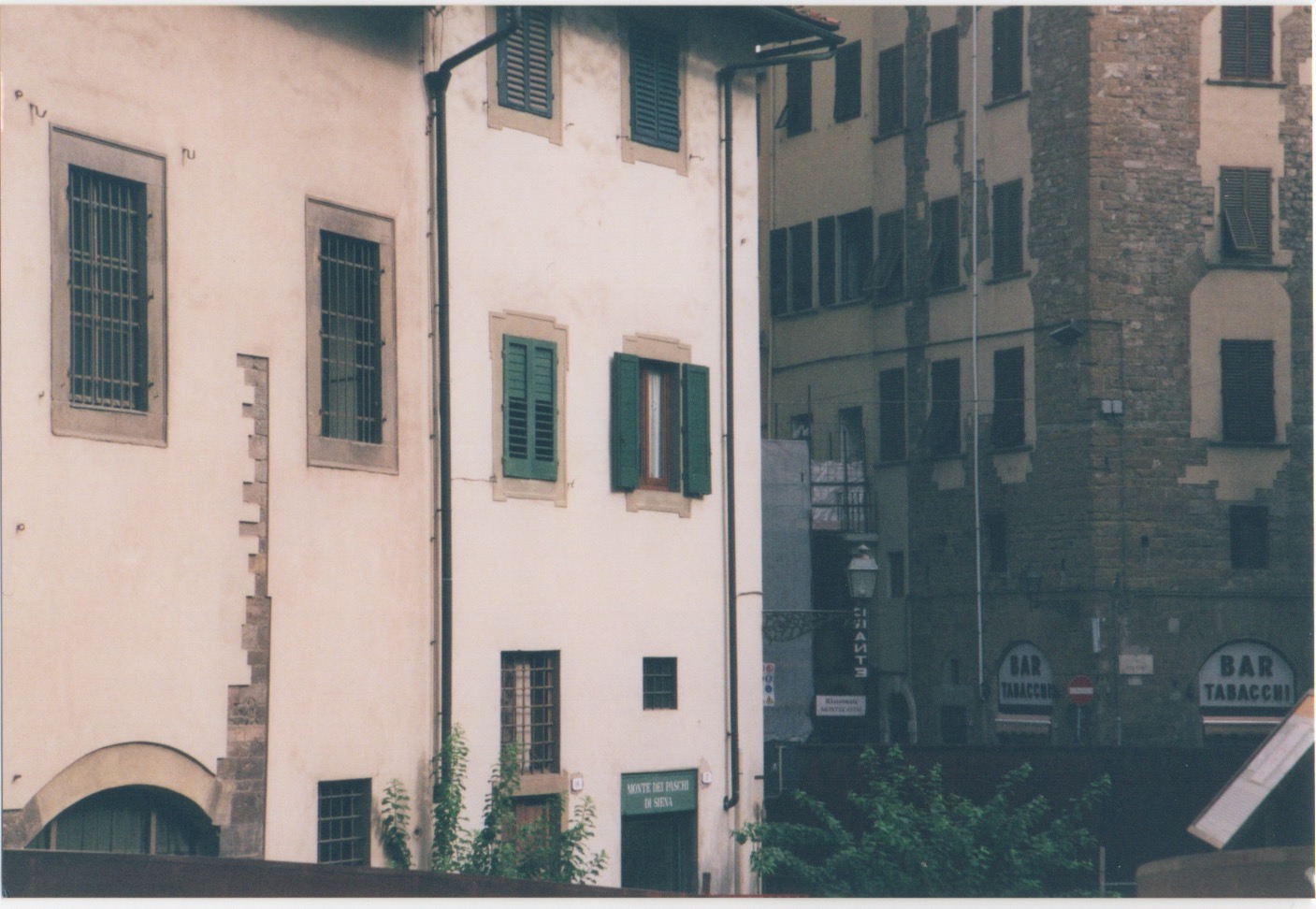
Montecatini Terme street scene

The Grand Hotel e La Place (NOT my hotel ...)


Bougainvillea in front of a modern bank building in Montecatini

Some of the most memorable moments of the trip were spent in this small spa town. In the evening, everyone ventures out into the streets for shopping, socializing, and coffee. I skipped the shopping, but was charmed by the coffee shops, which often feature delectable goodies to nibble along with the strong Italian coffees. I discovered that nougat candy could be fresh and melting and redolent of almond, unlike the dusty dry tablets I'd tasted Stateside.  Walking the streets until early morning was a pleasure to be savored. A small group of friends decided we needed to return, and open an American-style breakfast establishment in Montecatini (the typical Italian breakfast of an espresso and a hard roll with a bit of cheese or salami was not to everyone's taste. I, on the other hand, loved it).  Sadly, I don't think any one of us has yet returned. That may change ...

Montecatini sits in the foothills of some lovely mountains, and it is linked to an older town higher in the hills called Montecatini Alto. Alto can be reached by funicular from the spa town, and I was fortunate enough to take the trip. I was immediately charmed by Alto - its colorful homes, medieval churches, slanting streets and friendly residents:

We were told that this is the house of a renowned cook.

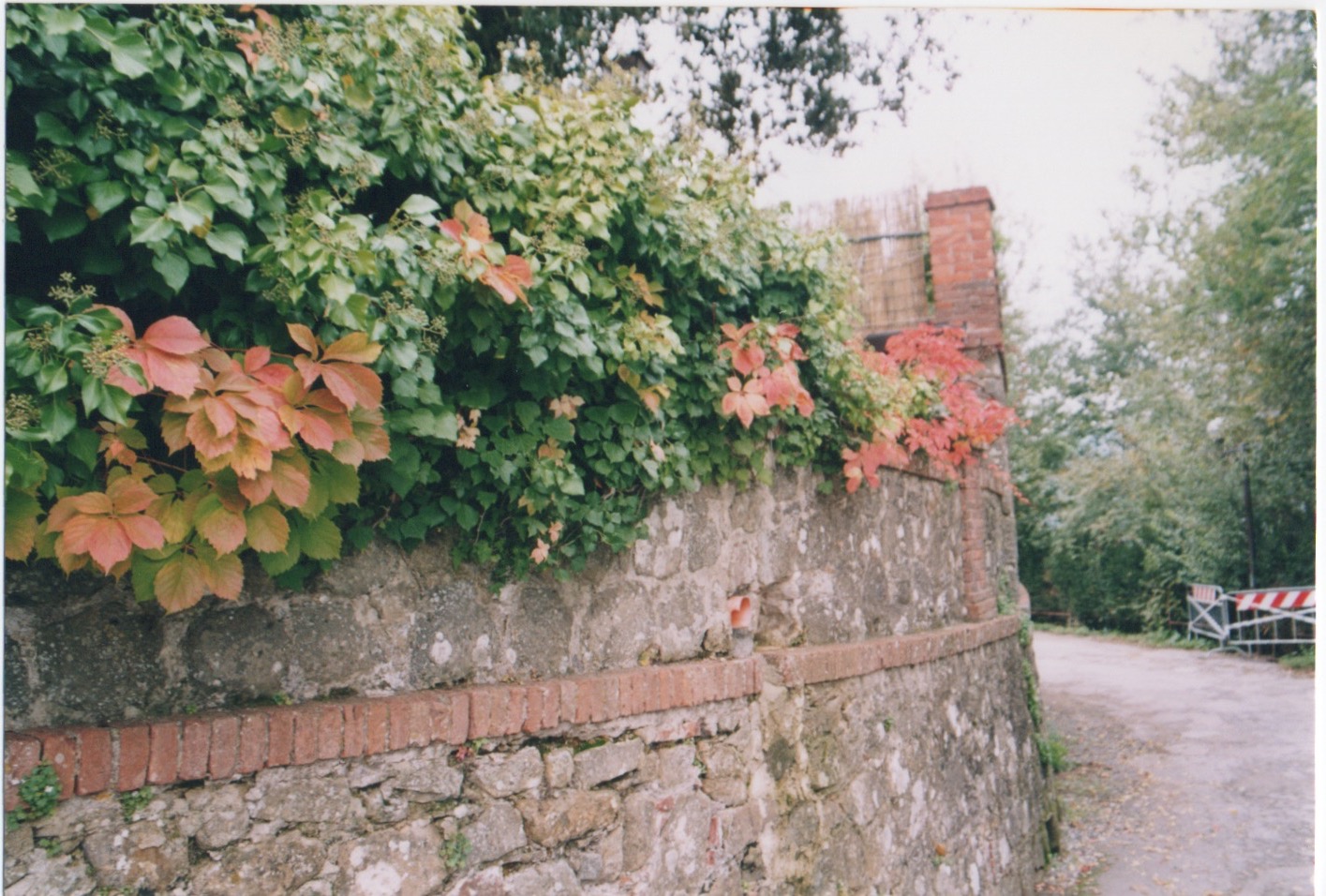
Turning leaves on an old stone wall


The streets of Montecatini Alto can get pretty steep
A beautiful terra-cotta horse head near the door
_________________________________________________________________________________

Memories of Italy - another food column

Last month, I re-published a column I'd written for my home town paper. Here's another from that series, and it's about my Italian journey. Although photos and stories in old magazines may be excellent spurs to the memory - and even a means of returning to a time and place - there is nothing like a good meal to REALLY accomplish time travel. I offer the following - for those who have experienced Italy, those who have gone, and especially for those who (like me) can't wait to return: 
 
Whether in Rome or Not… Eat Like the Romans Do!

”Forget the churches. Go for the food,” a knowledgeable mentor advised my friends Barbara, Mary and me as we set out recently on a whirlwind tour of Tuscany, Umbria, and Rome.  Well, our friend was half right!  Whether it was the unbelievable frescoes by Giotto and Cimabue that grace the Basilica of St. Francis in Assisi or Michelangelo’s breathtaking marble dome over St. Peter’s, we were dumbstruck by the magnificence to be found in the churches of Italy.  But we were equally impressed by the gustatory treasures we discovered.  And upon returning home, we were fortified by three simple goals: to rest our feet (beleaguered after tramping through half of the peninsula), to reconcile our sensibilities to the fact that our beloved Sox had FINALLY become the champions we always knew them to be, and to find the ways and means of recreating those exquisite Italian specialties we’d tasted and swooned over.

Well, my feet are once again functional, I don’t have to pinch myself every time I see a World Series Championship T-shirt, and I’ve been able to put together a half-decent Tuscan meal from the surprisingly lush offerings of nearby shops.  I still need to do a lot of experimenting and tasting before I’m satisfied, but here are a few suggestions for putting together a lovely meal with distinct overtones of Bella Italia.

We must start, of course, with an antipasto, and the best example of this course I tasted was in a rollicking trattoria in Rome.  At the beginning of an astonishing six-course meal, I was served a layered appetizer consisting of thin slices of delicious cured beef, topped with baby arugula and shavings of sharp Parmigiano-Reggiano.  The plate was dressed simply with a squeeze of fresh lemon juice.  Something so simple and so luscious should be easy to recreate, right? Well, yes, if you can find the requisite ingredients.  And residents of Burlington can do just that, ever since Lorella & Famiglia opened on Cambridge Street.  They sell bresaola, you see, which is the cured beef I loved in that Roman antipasto.  It’s expensive, but you will need just a quarter-pound (sliced thinly) to serve six lavishly.  Fan four or five slices out on a salad plate, top with a handful of baby arugula (which is easily found at Market Basket or Roche Bros.), and shave some very good Parmesan cheese over the top.  I brought back a kilo of the real stuff from Italy, but Lorella & Famiglia carry what looks and tastes just like the hunk I am using.  For your lemon juice dressing, try and find a Meyer lemon (at Whole Foods, perhaps), for these are slightly sweeter than regular lemons and match beautifully with the meat, greens and cheese. With this course, serve a bubbly Prosecco (Italy’s wonderful answer to vintage Champagne, and at a fraction of the cost).  This is a delicious appetizer for almost any meal, but if you want to vary it just a bit, the dry-cured capicola that can be found at La Cascia on Cambridge Street works just as well as the bresaola.

Now, a proper Italian meal would continue on to one of several primi piatti.  I suggest a sumptuous risotto made with dried porcini mushrooms for this course.  Again, you can obtain dried porcinis at Lorella & Famiglia, but they are widely available in other locations as well.  For the risotto, soak between 1 / 2 and one ounce of dried porcini mushrooms in one cup of warm water for about 30 minutes.  In the meantime, finely chop one small onion, and sauté slowly in one tablespoon olive oil in a heavy saucepan until it is tender and translucent.  Do not allow the onion to brown.  Add 1 / 3 cup Arborio rice to the onions, and sauté the grain lightly.  Squeeze the mushrooms until they are almost dry, and reserve the soaking liquid. Chop the mushrooms coarsely and add to the onions and rice.  Turn the heat to medium-low, and begin to strain the soaking liquid into the pot, about a quarter-cup at a time.  Stir vigorously with a wooden spoon until the liquid has become thoroughly absorbed by the rice.  Add another quarter-cup of liquid and continue the process until the liquid has been used.  Add 1 / 4 cup dry red wine to the risotto, and stir until the rice has absorbed the liquid.  Add 1 / 2 to 3 / 4 cup low-sodium fat-free beef broth to the risotto in small amounts, stirring each time until the rice has absorbed the liquid.  The whole process may take 45 minutes to an hour, but it is worth the effort and care involved.  Check the risotto to make sure the rice is thoroughly cooked, and to adjust seasoning. Add salt and freshly-ground pepper to taste.  It may require up to 1 / 2 teaspoon salt or more. The result of all this stirring should be a creamy porridge-like dish with the deep aroma and flavor of mushrooms.  If you want to make it even more luxurious, drizzle a little black truffle oil over the top of each serving. 

Serve the risotto with a green salad and a slice of Tuscan bread (made without salt), and pour a Chianti Classico to complement the wonderful flavors.

Now, I would stop right here, and have some fresh fruit and a café for dessert.  But those who are truly eating in the Italian manner may wish to proceed to the main course!  Here I might suggest a grilled meat dish, perhaps chicken or veal.  Roche Bros. has offered some excellent small veal chops in recent days, and Lorella boasts some wonderful-looking well-trimmed chops.  Add some roast potatoes, and your Tuscan meal will be complete.

And if all this sounds like too much time given to both preparation and to eating a meal, recall that in Italy dinner is an event in itself, rather than a prelude to some other activity.  Dinner should be planned and cooked with care, and consumed slowly, spiced with plenty of conversation, laughter, and good feeling.  So, invite family and friends to enjoy an Italian supper. Get out the linen napkins, light the candles, spin some Renaissance dances or Puccini on the stereo, and enjoy good food and togetherness. Buon appetito!